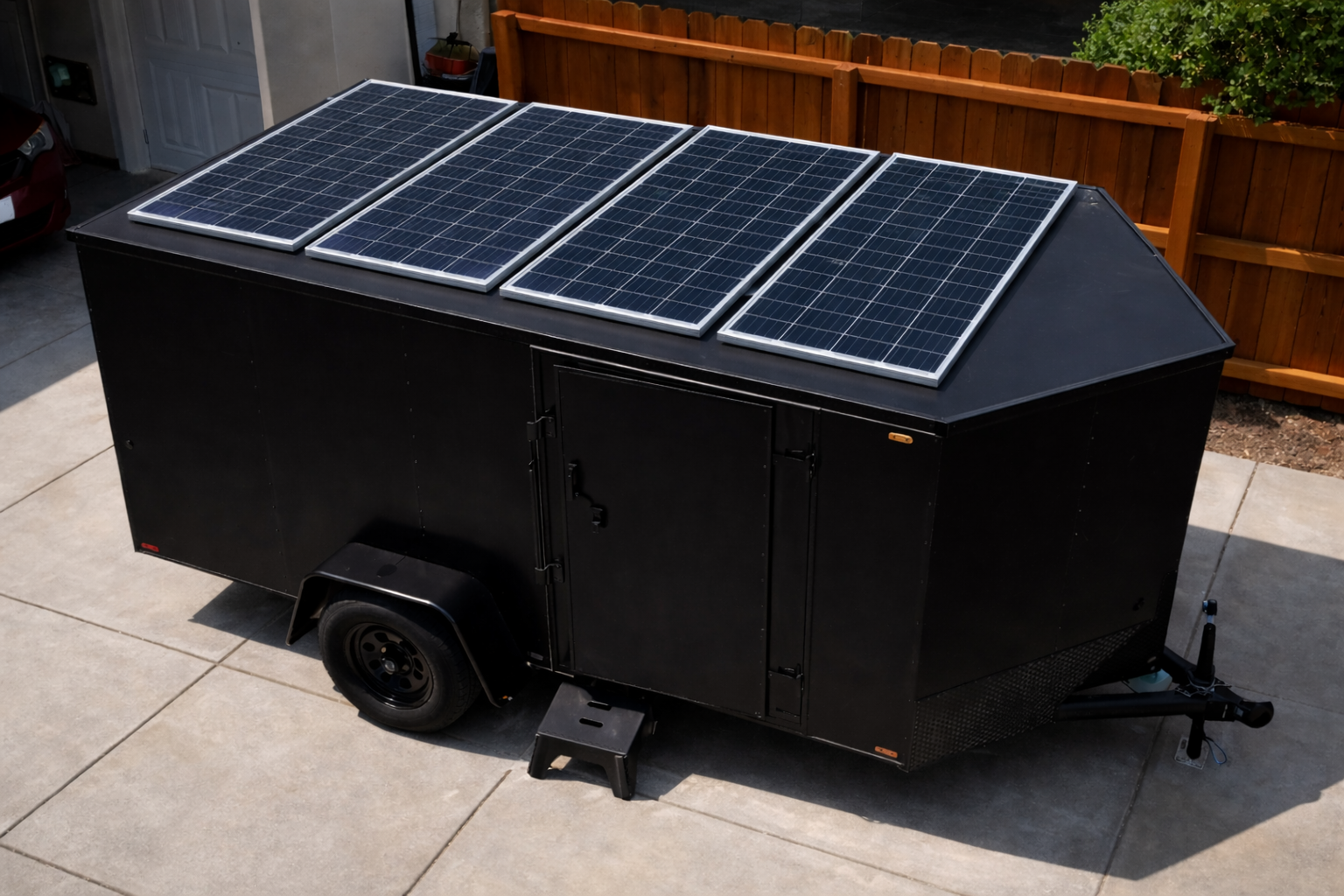

Utility Trailer Solar Power: What Actually Works (and What Doesn’t)
Utility trailer solar power gets talked about a lot—but most of what you’ll find online is either oversimplified, overly DIY-focused, or disconnected from how utility trailers are actually used in the real world.
If you’re relying on a utility trailer for job sites, mobile work, or even off-grid living, the difference between a system that looks good on paper and one that works day after day matters.
This article breaks down what actually works with utility trailer solar power, what commonly fails, and how to think about designing a system that won’t need to be redone later.
Why Utility Trailer Solar Is Different
Utility trailers are not RVs, vans, or campers—and treating them like they are is where most systems fall apart.
A utility trailer is often:
- Parked in open sun for long hours
- Used intermittently but intensely
- Expected to power tools, chargers, or appliances reliably
- Moved between locations with no shore power
That usage pattern changes everything. Solar power for a utility trailer has to be designed around real loads, real duty cycles, and real constraints—not just panel wattage.
What Doesn’t Work (Common Mistakes)
1. “Just Add Panels”
Panels alone don’t create usable power without:
- Proper charge control
- Adequate battery storage
- Correct system voltage
If all you think you need is solar, you will end up with energy you can’t use when you need it most. Solar panels are only one part of the system—not the system itself.
2. Undersized Batteries
This is the most common failure point. Many utility trailer solar setups fail because the battery bank is sized too small for:
- Tool charging cycles
- Inverter surge loads
- Consecutive workdays without sun
When batteries are undersized, the system technically works but becomes unreliable, frustrating, and short-lived.
3. Portable Power Stations as a “Solution”
Portable power stations can be convenient, but they fall short for most work trailers.
Common issues include:
- Limited surge capacity
- Slow recharge times
- Poor scalability
- Short service life under daily use
They’re often fine for occasional use—but not for utility trailers that are part of someone’s livelihood.
4. No Electrical Protection or Planning
DIY setups often skip:
- Proper fusing
- DC and AC separation
- Load calculations
That doesn’t just hurt performance—it creates safety and reliability issues over time.
What Does Work for Utility Trailer Solar Power
1. Designing Around How the Trailer Is Used
The starting point is not “how many panels fit on the roof.”
It’s:
- What tools or appliances are being powered
- How long they’re used each day
- Whether loads are AC, DC, or both
- How many days of autonomy are needed
A system designed around usage will always outperform one designed around components.
2. A Battery Bank Sized for Reality
A reliable utility trailer solar system typically prioritizes battery capacity first.
Why?
- Batteries buffer inconsistent solar production
- They handle surge loads from tools and appliances
- They allow work to continue even on cloudy days
A properly sized battery bank is what turns solar into dependable power.
3. Proper Voltage and Distribution
Well-designed systems use:
- Appropriate system voltage (often 24V or 48V for larger loads)
- Clean DC distribution
- Dedicated AC circuits when needed
This improves efficiency, reduces losses, and makes future expansion possible.
4. Expandability Built In
Utility trailer needs change.
What works today may not be enough in a year.
Good systems are designed so you can:
- Add panels later
- Increase battery capacity
- Integrate shore power or vehicle charging
without tearing everything out and starting over.
Jobsite Use vs Off-Grid Living (The Same Rules Apply)
Whether a utility trailer is used for:
- Construction or trade work
- Mobile businesses
- Off-grid living conversions
The fundamentals don’t change.
Reliable utility trailer solar power always comes down to:
- Correct system sizing
- Proper electrical protection
- Clean installation
- Realistic expectations
The difference is scale—not principles.
Who Utility Trailer Solar Power Is For
Solar power works extremely well for utility trailers when:
- Quiet operation matters
- Fuel logistics are a problem
- The trailer sits in open sun
- Power demand is predictable
It’s especially effective for:
- Contractors charging cordless tools
- Mobile service businesses
- Off-grid work trailers
- Remote job sites
When Solar Alone May Not Be Enough
Solar isn’t magic.
In some cases, the best solution is a hybrid approach:
- Solar + battery
- Shore power when available
- Optional generator backup
A good system is one that supports how you actually work—not one that forces compromises.
The Bottom Line
Utility trailer solar power works extremely well when it’s designed properly—and fails quickly when it isn’t.
The biggest difference between success and frustration is not brand choice or panel count.
It’s system design.
If you’re considering solar for a utility trailer—whether for job sites or off-grid use—the smartest first step is understanding what you need the system to do before choosing components.
Thinking About Power for Your Utility Trailer?
If you’re exploring a solar power system for a utility trailer and want it done right the first time, this page explains how we design systems for both jobsite and off-grid use:


