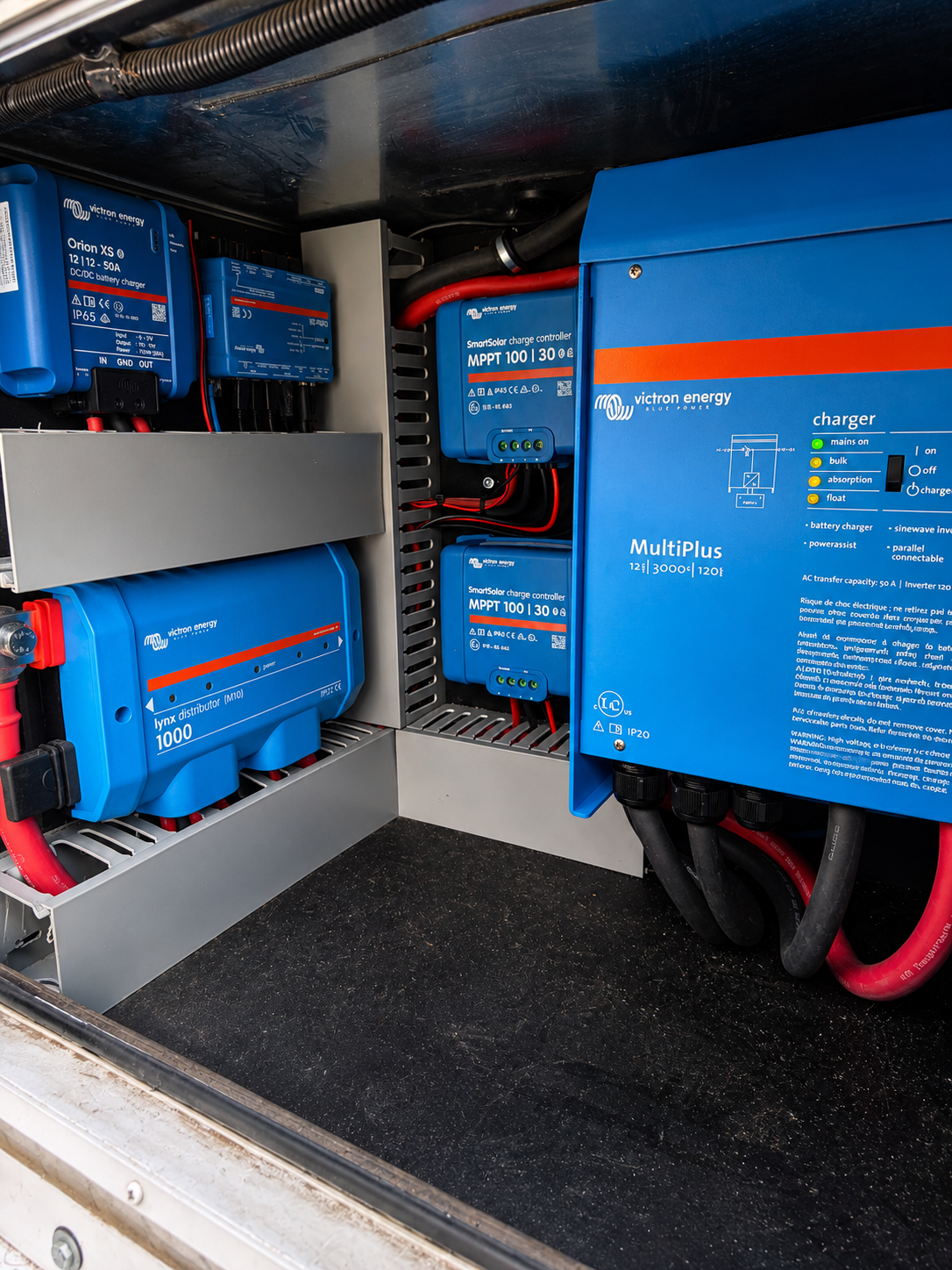

At Cascade RV Solar Solutions, some of the most rewarding projects are also the most challenging. This Arctic Fox Camper Solar Upgrade was one of the most challenging and rewarding projects we’ve completed at Cascade RV Solar Solutions. Limited installation space, previous wiring issues, and the need for a complete electrical redesign required careful planning and execution.
Like many truck campers, every inch of available space mattered. The goal was simple: improve system reliability, increase battery capacity, enhance charging capability, and create a safer electrical system that would support the owner’s off-grid adventures for years to come.
The Original System
The camper arrived with:
- Four 100Ah Battle Born lithium batteries
- Renogy 3000W inverter
- Existing rooftop solar
- Automatic Transfer Switch (ATS)
The inverter had been wired to the secondary input of the transfer switch, allowing the coach to automatically switch between shore power and inverter power.

While the system functioned, our inspection uncovered several issues commonly found in high-current RV electrical installations:
- Undersized inverter cabling
- Multiple conductors lacking proper short-circuit protection
- Hardwired circuits without appropriate overcurrent protection
- Limited future expansion capability
- Inefficient use of available installation space
These issues are not always immediately visible to RV owners. In many cases, a system may appear to work normally while still containing hidden safety concerns.
Why Wire Sizing Matters
One of the most significant issues we discovered was the inverter cabling.
A 3000-watt inverter operating on a 12-volt battery system can draw well over 250 amps under heavy loads. When conductors are undersized, several problems can occur:
- Excessive voltage drop
- Reduced inverter performance
- Increased heat generation
- Nuisance shutdowns
- Potential fire hazards
To address this, we removed the undersized conductors and installed properly sized 4/0 battery cables feeding a new Victron MultiPlus inverter/charger through a protected distribution system.
Upgrading the Battery Bank
The original battery bank consisted of four separate 100Ah lithium batteries.
For this Arctic Fox Camper Solar Upgrade we replaced the bank with a single 460Ah Epoch Essentials lithium battery.
Benefits included:
- Simplified wiring
- Reduced connection points
- Improved battery monitoring
- Increased usable capacity
- Easier maintenance
- Better utilization of available space
In compact RV installations, reducing complexity often improves reliability.
Expanding Solar Capability

We also upgraded the solar charging system by adding an additional Victron SmartSolar MPPT charge controller.
The new controller was dedicated to a portable solar input designed specifically for the customer’s Renogy 400W solar blankets
This provides several advantages:
- Portable solar can be positioned in direct sunlight while the camper remains in the shade.
- Independent charging sources improve energy harvest.
- Additional charging capacity reduces generator dependence.
Modern MPPT charge controllers maximize solar harvest and continuously optimize panel performance under changing weather and shading conditions. Victron’s MPPT technology is specifically designed to maximize available solar production under varying conditions.
The Slide-Out Challenge
One of the most difficult aspects of this project involved the battery installation location.
The customer’s preferred battery location was mounted on a sliding platform. This created a unique engineering challenge:
How do you safely move hundreds of amps of battery power between a moving structure and a fixed electrical distribution system?
The solution required:
- Proper cable routing
- Strain relief
- Protection against abrasion
- Controlled cable movement
- Careful clearance management
We designed a cable guidance system that allows the battery cables to move safely as the slide extends and retracts.
Because every RV and slide mechanism is different, we also provided the customer with specific operating instructions to visually inspect the cable loop during slide operation to ensure proper movement and prevent pinching.
Small RVs Create Big Design Challenges
Many RV owners assume a smaller camper requires a simpler electrical system.
In reality, the opposite is often true.
Large fifth wheels and motorhomes usually offer dedicated electrical bays with generous working clearances. Truck campers frequently require:
- Creative equipment placement
- Advanced cable routing
- Careful ventilation planning
- Strategic service access considerations
- Precise battery placement
Every component must work together as part of a complete electrical ecosystem.
What RV Owners Should Look For
When evaluating a solar or lithium battery installation, ask these questions:
- Are all battery conductors properly protected by fuses or breakers?
- Are inverter cables sized appropriately for the expected current?
- Is the charging system compatible with lithium batteries?
- Is the equipment accessible for future service?
- Is cable routing protected from vibration and abrasion?
- Has future expansion been considered?
The answers to these questions often determine whether a system remains reliable for years or becomes a source of ongoing problems.
The Final Result
The completed Arctic Fox Camper Solar Upgrade now features:
- 460Ah Epoch Essentials lithium battery
- Victron MultiPlus 3000 inverter/charger
- Victron SmartSolar MPPT charge controllers
- Dedicated portable solar capability
- Properly sized 4/0 inverter cabling
- Protected DC distribution architecture
- Improved serviceability
- Expanded off-grid capability
Most importantly, the system was redesigned with safety, reliability, and long-term performance as the primary objectives.

Thinking About Upgrading Your RV?
Whether you’re building a new off-grid system or correcting issues from a previous installation, proper design matters.
At Cascade RV Solar Solutions, we specialize in custom RV electrical systems designed specifically for the way you travel. Every installation is built around safety, performance, and real-world usability—not simply fitting components into available space.
This Arctic Fox Camper Solar Upgrade transformed the camper from a functional but limited system into a safer, more capable off-grid power solution.


