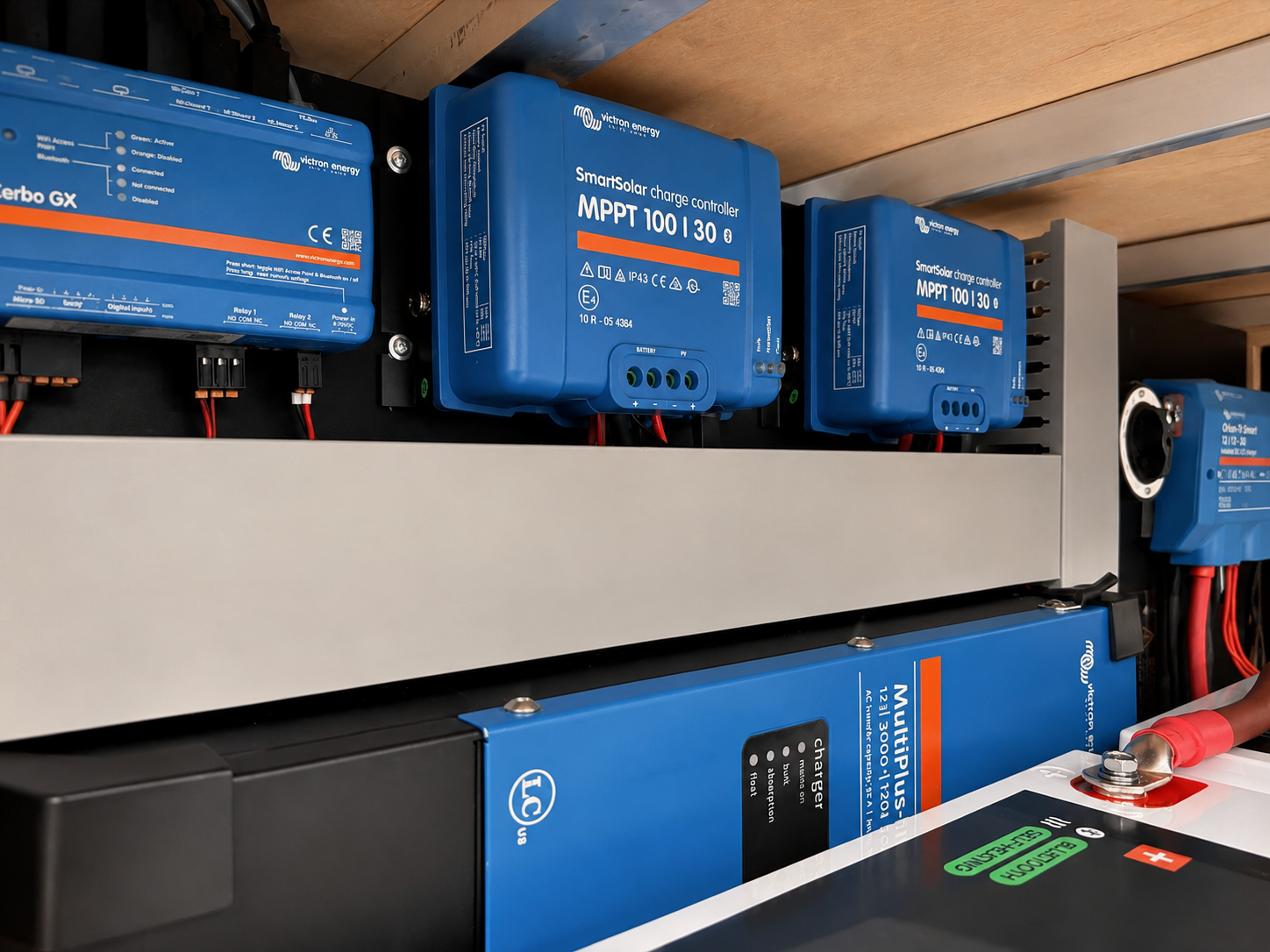

RV Solar Installation Problems in Tight Spaces
RV Solar Installation quality matters more than most RV owners realize. As lithium battery banks, Victron inverter systems, and off-grid power demands continue to grow, many RV solar installations are being forced into extremely tight compartments that were never designed for modern electrical systems.
The result is a growing number of RV electrical systems operating outside manufacturer-recommended specifications — especially when it comes to airflow, heat dissipation, and serviceability.
At Cascade RV Solar Solutions, we regularly encounter these limitations. The difference is that we design around them intentionally.
A Victron System Is More Than a Collection of Components
A properly designed Victron system should be viewed holistically. The inverter/charger, solar charge controllers, battery bank, shunt, busbars, cabling, fusing, and monitoring system all work together.
When one component is compromised by poor installation practices, the entire system can suffer.
The Hidden Problem With Tight RV Solar Installation
One of the biggest mistakes in RV electrical upgrades is focusing only on whether the equipment physically fits.
Just because a MultiPlus-II inverter, SmartSolar MPPT, lithium battery, or Lynx Distributor can be mounted in a compartment does not mean it should be installed there without considering clearance, airflow, heat, and future service access.
High-output inverter/chargers and solar charge controllers generate heat under load. When OEM clearance specifications are ignored, several problems can appear:
- Thermal derating
- Reduced charging performance
- Inverter shutdowns under load
- Premature fan wear
- Excessive compartment heat buildup
- Reduced lithium battery lifespan
- Communication instability
- Difficult troubleshooting and service access
Heat Is the Enemy of RV Solar Installation Performance
Many Victron components are designed to protect themselves when temperatures rise. That protection is useful, but it also means the system may reduce output or shut down when airflow is restricted.
Heat also compounds across the system:
- MPPT charge controllers add heat to the compartment
- Inverter cooling fans may recirculate warm air
- Lithium batteries warm during charging and discharging
- DC cabling and busbars generate heat under sustained load
- Closed RV compartments trap thermal energy
A system may test fine in the shop, but struggle later during summer boondocking, high inverter loads, generator charging, or long periods of heavy solar production.
The OEM Clearance Problem
Manufacturers publish clearance requirements for a reason. These requirements help ensure proper airflow, safe heat dissipation, and reliable long-term operation.
In RVs, we often see installations where components are packed tightly together because the installer is trying to maximize battery capacity or hide the equipment behind panels.
Common problems include:
- MPPT controllers mounted too close together
- Inverters installed with limited top or side clearance
- Zero-airflow compartments
- DC cabling blocking cooling vents
- Cerbo GX devices buried behind batteries
- SmartShunts or fuses installed where they cannot be accessed
- Components mounted in orientations that reduce cooling performance
How Cascade RV Solar Solutions Fixes These Problems
At Cascade RV Solar Solutions, we approach tight-space installations differently. We do not only ask, “Can this equipment fit?”
We ask, “Can this system operate safely and reliably under real-world conditions?”
1. We Design the Entire Victron Ecosystem Together
A professional RV Solar Installation works best when every component is selected and installed as part of a complete electrical ecosystem.
The Cerbo GX provides system communication and monitoring. The SmartShunt or Lynx Shunt provides accurate battery data. The SmartSolar MPPT controllers manage solar charging. The MultiPlus-II or Quattro manages inverter power, shore power, generator input, and battery charging.
When these devices are installed correctly and configured properly, the system can operate more intelligently and provide better diagnostic visibility.
Victron provides detailed thermal, installation, and monitoring documentation for their systems through the Victron Energy website and VRM platform.
2. We Prioritize Airflow Paths
In tight compartments, airflow has to be designed intentionally.
Depending on the RV and system layout, this may include:
- Vertical mounting where appropriate
- Strategic spacing between heat-producing components
- Ventilation cutouts
- Passive airflow channels
- Active cooling fans
- Separating batteries from high-heat electronics
- Routing cables so they do not block vents or service panels
3. We Build for Serviceability
A system that cannot be serviced properly is a future failure point.
We design access for:
- Fuse replacement
- Battery isolation
- Firmware updates
- VE.Bus diagnostics
- SmartShunt access
- Cerbo GX cable management
- Thermal inspection
This matters in RVs because vibration, dust, road movement, and temperature swings are part of normal use.
4. We Use Monitoring to Validate the System
One major advantage of the Victron ecosystem is the ability to monitor system behavior through the Cerbo GX and VRM platform.
This allows us to review:
- Battery state of charge
- Solar harvest
- Inverter loading
- Charging performance
- DC current flow
- Temperature-related performance issues
- System alarms and fault history
A completed system should do more than simply turn on. It should operate predictably under real-world use.
Tight Spaces Require Better Engineering — Not Shortcuts
RV solar systems are becoming more advanced every year. Customers want larger lithium banks, bigger inverters, residential refrigerators, air conditioner support, Starlink integration, generator charging, and longer boondocking capability.
As these systems grow, installation quality matters more than ever.
The easiest way to install a system in a tight compartment is to ignore clearance, heat, and serviceability. The correct way is to engineer around those limitations.
That may require custom mounting solutions, redesigned airflow, cleaner cable routing, distributed component layouts, and a complete understanding of how the Victron system operates as a whole.
Final Thoughts
There is a major difference between fitting components into an RV and designing a true off-grid electrical system.
At Cascade RV Solar Solutions, we specialize in building high-performance Victron-based systems that are designed for real-world RV use — including the tight spaces where many installations fail.
Thermal management, monitoring, communication, and serviceability are not optional details.
They are part of the design.
Solar Powered
Sustainable Off-Grid RV Solar Solutions
Designing, installing, and optimizing custom RV solar solutions for efficient, green, off-grid experiences.


