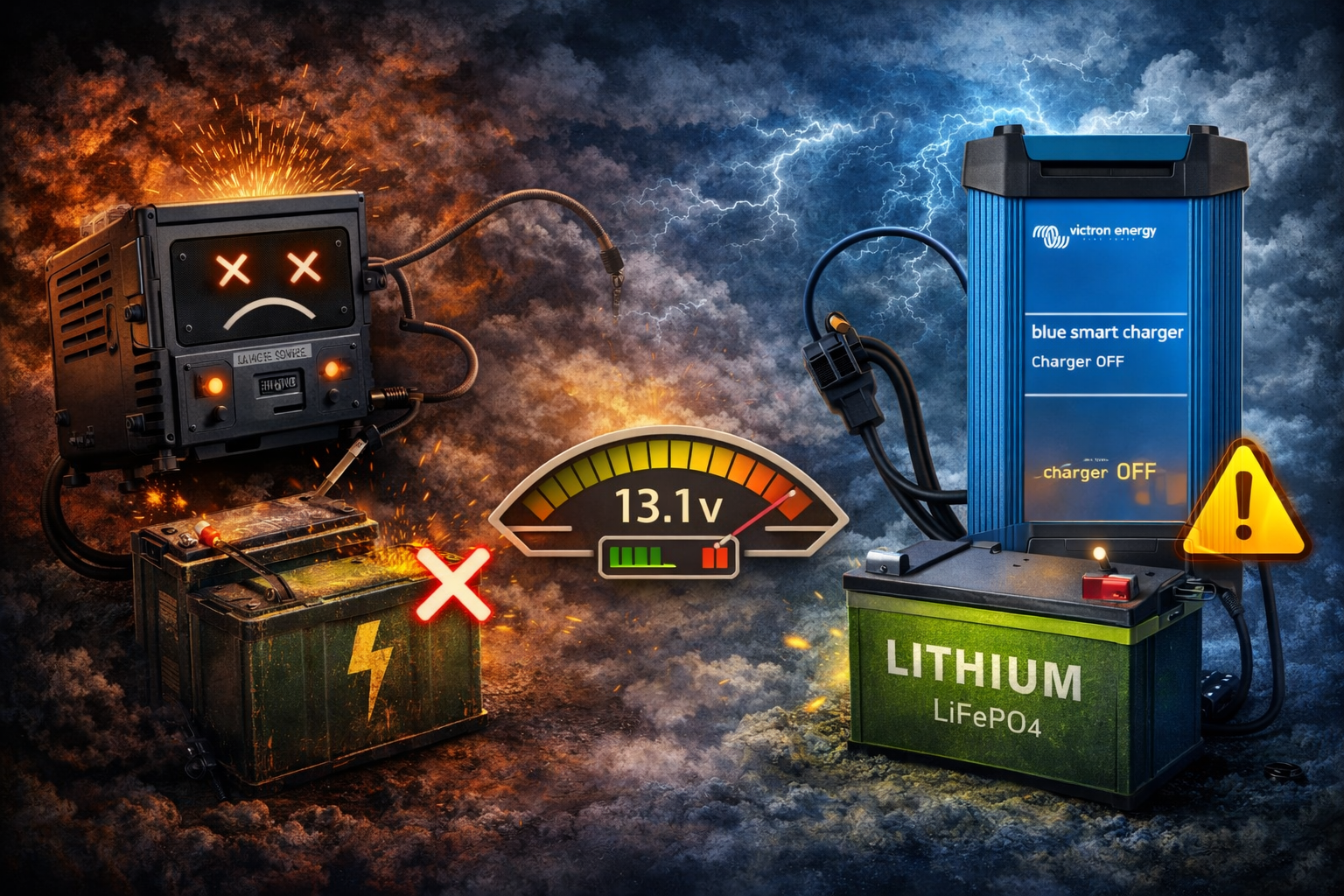

Why RV Converters Don’t Charge Lithium Batteries (And What to Do Instead)
If your RV converter is not charging a lithium battery, you’re not alone—this is one of the most common problems RV owners run into when upgrading from lead-acid to lithium. On the surface, it looks like the converter should still do its job. Shore power is connected, the system appears normal, and yet the battery is not charging the way it should.
In many cases, the converter is not actually broken. The real issue is that most factory RV converters were designed around lead-acid charging behavior, not lithium battery chemistry. That mismatch is exactly why so many RV owners end up confused when their upgraded battery bank underperforms on shore power.
Why Your RV Converter Is Not Charging a Lithium Battery
A traditional RV converter is built to charge lead-acid batteries, which behave very differently from lithium iron phosphate (LiFePO4) batteries.
Lead-acid batteries drop voltage relatively quickly as they discharge. That makes it easy for a standard converter to “see” that the battery needs charging and respond accordingly. Lithium batteries, on the other hand, maintain a much flatter voltage curve for most of their usable capacity.
That means a lithium battery can be significantly discharged and still show a voltage that looks “normal” to an older converter. As a result, the converter may not properly ramp into a useful charge cycle, or it may sit at a voltage that is too low to fully charge the battery.
- Lead-acid batteries show a clearer voltage drop during discharge
- Lithium batteries hold voltage steady for much longer
- Many stock converters misread lithium battery state of charge
- The converter may never enter a proper lithium charging profile
This is the core reason an RV converter not charging lithium battery is such a common upgrade issue.
Signs Your RV Converter Isn’t Charging Lithium
There are several common signs that point to converter incompatibility rather than a bad battery or wiring fault.
- Battery voltage stays nearly unchanged when shore power is connected
- The battery does not recover to full charge after extended time plugged in
- Charging voltage remains too low for proper lithium charging
- The system appears connected, but battery capacity keeps dropping over time
- The battery charges fine from solar or a DC-DC charger, but not from shore power
In the field, this often shows up as a customer saying, “I’m plugged in, but the batteries still aren’t full.” That usually leads people to suspect the battery first, when the actual problem is the charging source.
Why Lead-Acid RV Converters Fail with Lithium Batteries
Most OEM converters are built around lead-acid charging voltages and basic charging logic. Many of them spend a lot of time around voltages like 13.6V, which may be acceptable for maintaining a lead-acid battery but are often inadequate for properly charging lithium batteries to full capacity.
Lithium batteries generally need a charging profile that intentionally reaches proper bulk and absorption voltage. If the converter never gets there—or only gets there inconsistently—the battery remains undercharged.
That creates several real-world problems:
- Reduced usable battery capacity
- Misleading battery state-of-charge assumptions
- Poor shore power charging performance
- Customer frustration during a lithium upgrade
The issue is not that lithium batteries are difficult. The issue is that the original charging equipment was never designed for them.
What to Do Instead: Use a Lithium-Compatible Charger
The correct fix is usually straightforward: replace or bypass the incompatible converter and install a charger that is designed to properly charge lithium batteries.
A dedicated lithium-compatible charger provides the correct voltage profile and charges intentionally instead of relying on outdated converter behavior. This is why upgrading to a charger such as a Victron unit is often the cleanest long-term solution in an RV lithium conversion.
A proper lithium charger gives you:
- Correct bulk and absorption charging voltage
- More reliable charging from shore power
- Better battery performance and recovery
- Predictable charging behavior instead of guesswork
- App-based monitoring and setup on many smart chargers
Build the Entire Charging System Around Lithium
When upgrading an RV to lithium, it helps to think beyond just the battery. The battery is only one part of the system. The charging equipment has to match the chemistry too.
That typically means evaluating all charging sources:
- Shore power charger
- Solar charge controller
- Alternator charging through a DC-DC charger
- Inverter/charger settings, if applicable
If one charging source is outdated, the entire system can feel inconsistent. That is why properly sizing your RV electrical system matters just as much as choosing the right battery. You can explore that process here: RV solar and electrical system planning tool.
Bottom Line
If your RV converter is not charging a lithium battery, the most likely explanation is not a mystery and not a bad battery. In many cases, the converter is simply not compatible with lithium charging requirements.
Traditional converters were built for lead-acid systems. Lithium batteries require different charging behavior, different voltage targets, and a more intentional approach. Once that mismatch is corrected, the system usually performs the way the owner expected from the beginning.
If you are upgrading your RV electrical system and want it designed correctly the first time, Cascade RV Solar Solutions can help you build a charging system that actually works with lithium—not against it.
Solar Powered
Sustainable Off-Grid RV Solar Solutions
Designing, installing, and optimizing custom RV solar solutions for efficient, green, off-grid experiences.


