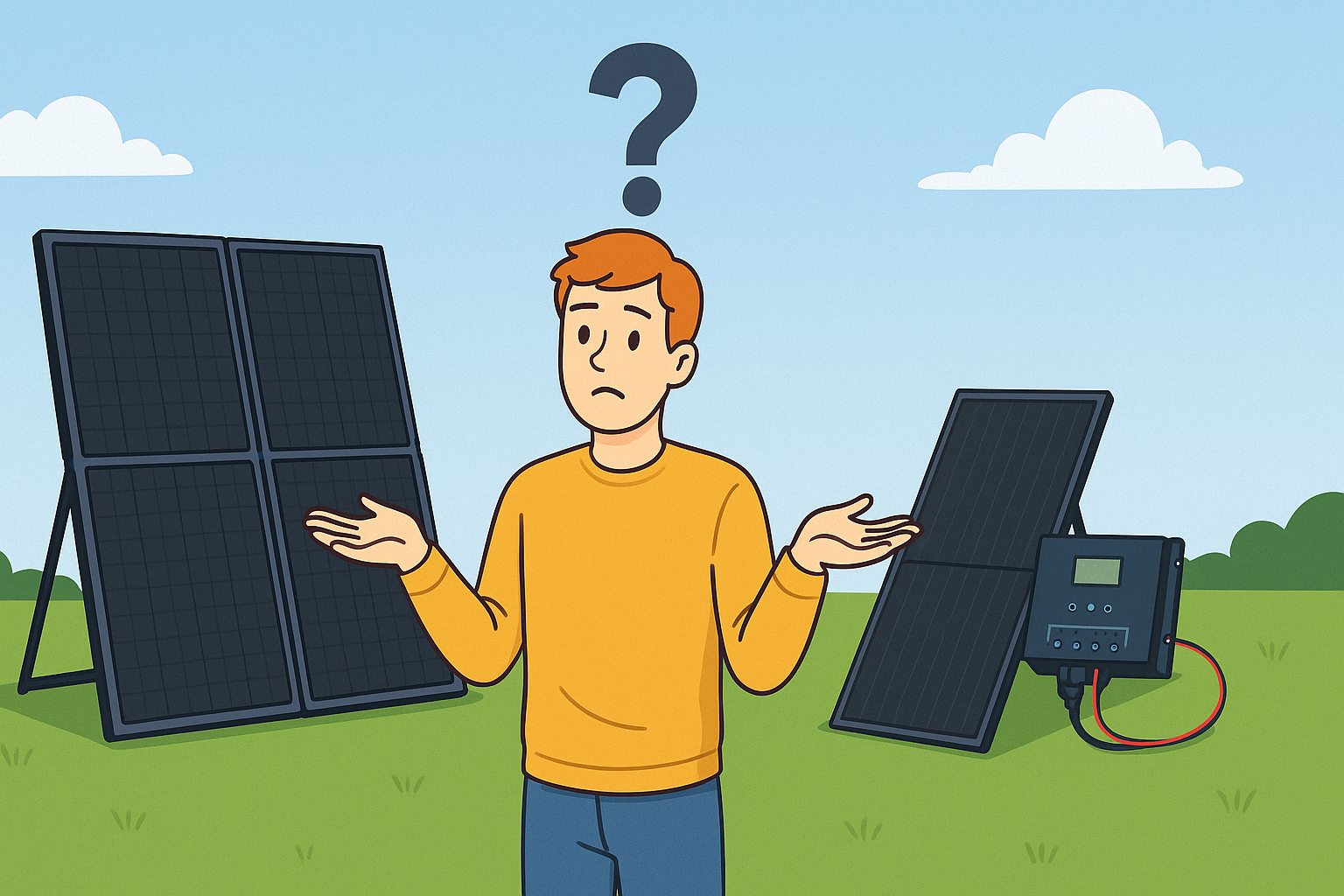

If you’re researching portable solar panels for RVs, this guide breaks down two of the best options and how they perform in real-world camping situations. Portable solar panels have become one of the most useful add-ons for RV owners—whether you’re boondocking deep in the forest, parked lakeside for the weekend, or just need a little extra charging power to support energy-hungry DC refrigerators and CPAP machines.
At Cascade RV Solar Solutions, we install a lot of portable solar options for customers who want a flexible setup without committing to a full roof-mounted array.
In this blog, we’ll break down two of the most popular portable solar panel configurations, explain how they work, and help you choose the one that fits your RV lifestyle best.
This is our premium portable solar solution—built for people who want maximum efficiency, plug-and-play simplicity, and seamless compatibility with their existing RV solar system. Among the most efficient portable solar panels for RVs, the Renogy 400W panel paired with a Victron MPPT controller stands out for power and expandability
How It Works
- You get a 400W Renogy portable panel (a solid performer in real-world conditions).
- Then we pair it with a Victron SmartSolar 100/30 MPPT charge controller, installed inside the RV.
- Lastly, we install a bulkhead solar adapter port, so all you do is plug in the portable panel when you need it.

Why This Setup Is Awesome
1. MPPT Efficiency
MPPT charge controllers can give you 20–30% more usable power compared to PWM controllers—especially in colder weather, partial shade, or when panel voltage is higher than battery voltage.
2. Works Seamlessly With Your Existing Rooftop Solar
If your existing charge controller is Victron, we can link both controllers through the Victron Virtual Network (VE.Smart Networking).
This syncs charging stages so your roof and portable array work together instead of “arguing” about voltage.
The result:
- Better battery health
- Faster charging
- Smarter distribution of available solar power
3. True Plug-and-Play
Your RV keeps the charge controller safely mounted inside. The portable panel connects to the bulkhead adapter, and everything auto-runs.
No fussing with clips, dusty controllers on the ground, or extra cables.
4. Great for Bigger Battery Banks
If you’re running LiFePO₄ batteries, large DC compressors, Starlink, or long boondocking trips, the 400W panel can supply meaningful daily charging—sometimes 20–30 Ah more per hour than suitcase-style PWM setups.
Who This Is Best For
- Full-time RVers
- People with Victron systems already installed
- Those running large loads (Dometic/ICECO fridge, MaxxAir fan, inverter use)
- Customers needing multiple charge sources working in harmony

Many people looking for portable solar panels for RVs also consider suitcase-style systems like the Renogy 200W foldable panel with a built-in PWM controller.
How It Works
- The panel includes a built-in PWM solar charge controller.
- You attach it directly to your battery bank using alligator clips or a battery-port adapter.
- No additional controller installation required.
Advantages
1. Simple and Affordable
Everything is built into the panel. No wiring inside the RV.
For someone just starting out, it works right out of the box.
2. Great Backup System
If your rooftop solar is small or nonexistent, the suitcase can safely top up your batteries when camping off-grid.
3. Versatile Between RVs
If you have a:
- Truck camper
- Towable
- Travel trailer
- Second RV
…you can move the suitcase between them easily.
Disadvantages
1. PWM Efficiency Loss
- PWM controllers are older tech.
- Expect 15–30% less output compared to MPPT, depending on conditions.
2. Doesn’t Integrate With Existing Solar
If you already have a rooftop solar charger, the suitcase PWM controller operates completely independently.
This can lead to:
- Voltage conflicts
- Inefficient charging
- Reduced performance with LiFePO₄ batteries
3. Controllers Sitting on the Ground
The charge controller is exposed to:
- Dust
- Moisture
- Heat
- Physical damage
This shortens its lifespan compared to a hard-mounted Victron unit.
4. Limited for Larger Battery Banks
If you’re running:
- Lithium batteries
- Large loads
- Refrigerators or Starlink
The 200W suitcase may provide limited daily recovery, especially in cloud or shade.
Who This Is Best For
- Weekend campers
- Budget-conscious RVers
- People with small AGM battery banks
- Anyone wanting a simple “clip it to the battery and go” solution
Side-by-Side Comparison
Both of these portable solar panels for RVs serve different needs depending on battery size, camping style, and budget
| Feature | 400W Renogy + Victron MPPT (Option 1) | 200W Renogy Suitcase with PWM (Option 2) |
|---|---|---|
| Charging Efficiency | ★★★★☆ (High – MPPT) | ★★☆☆☆ (Moderate – PWM) |
| Cost | Higher | Lower |
| Ease of Setup | Installed once → plug-and-play forever | Easy out of the box |
| Integration with Existing Solar | Excellent (via Victron Virtual Network) | None |
| Ideal For | Full-timers, lithium users, high-demand systems | Weekend campers, lightweight use |
| Durability | Controller protected inside RV | Controller exposed to outdoors |
| Power Output | 400W | 200W |
Which One Is Right for You?
Choose Option 1 (400W + Victron MPPT) if you:
✔ Already have (or want) a Victron system
✔ Run lots of 12V loads
✔ Boondock for long stretches
✔ Want the highest performance and efficiency
✔ Want a clean, durable, plug-and-play solution
Choose Option 2 (Renogy 200W Suitcase with PWM) if you:
✔ Want the cheapest entry point
✔ Only camping occasionally
✔ Don’t need high charging performance
✔ Want portable solar with zero installation
Need Help Choosing?
Choosing the right portable solar panels for RVs makes a huge difference in how long you can comfortably boondock and how fast your batteries recharge. If you want help deciding which portable solar option fits your RV setup, we offer free consultations and can walk through your batteries, loads, and camping style to recommend the right system.
Just reach out anytime—we love helping people build the perfect off-grid setup. Both of these portable solar panels for RVs offer flexible ways to boost your charging capacity depending on how and where you camp
Solar Powered
Sustainable Off-Grid RV Solar Solutions
Designing, installing, and optimizing custom RV solar solutions for efficient, green, off-grid experiences.


