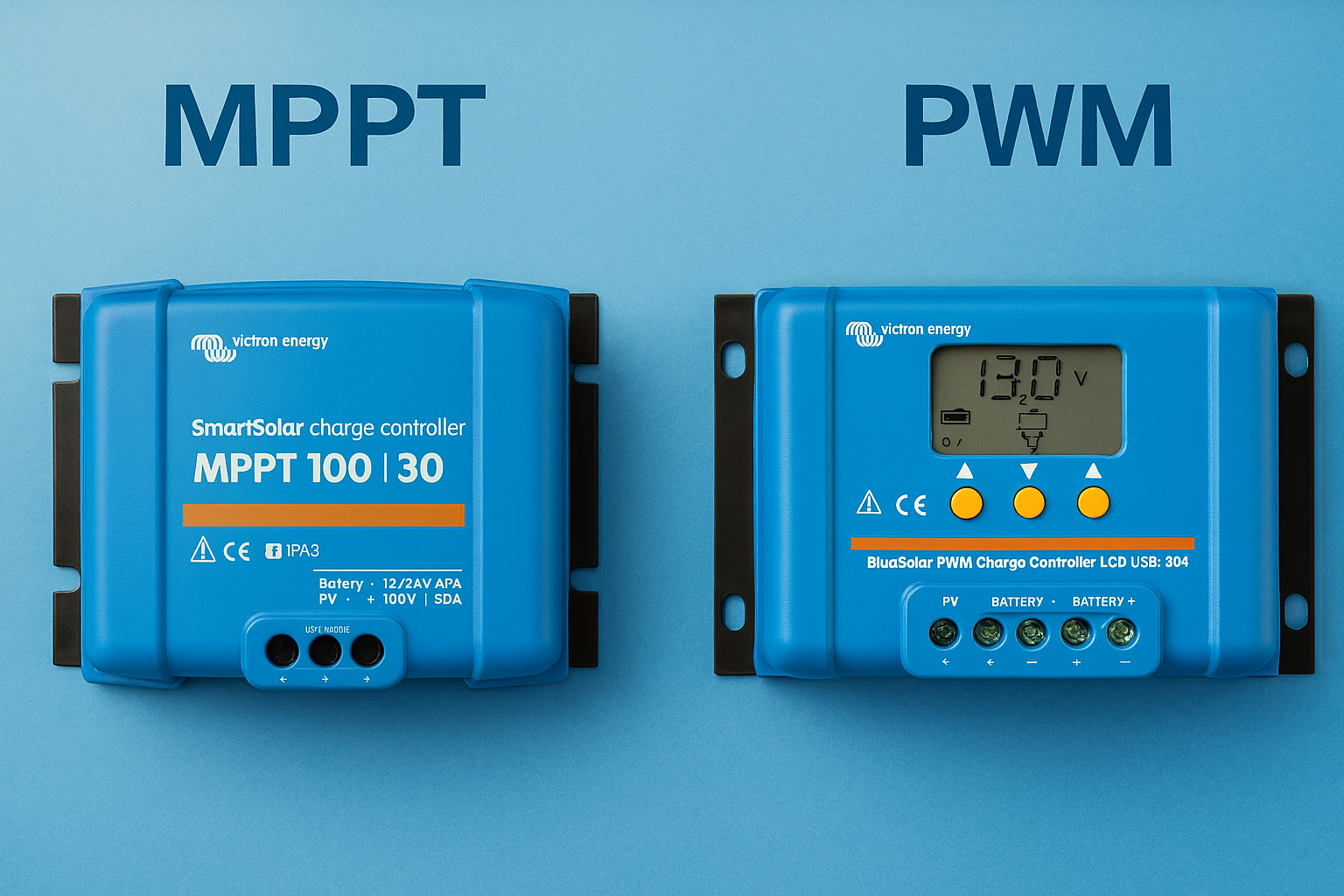

If you’re building or upgrading your RV solar system, you’ve probably come across the terms MPPT and PWM when researching solar charge controllers. While both serve the same purpose — regulating the voltage and current coming from your solar panels to your batteries — they work in very different ways, and the choice between them can significantly impact system performance and cost.
In this guide, we’ll break down what each type of controller does, how they compare, and when it makes sense to use one over the other in your off-grid RV system.
What Does a Solar Charge Controller Do?
Before we compare MPPT vs PWM, it’s helpful to understand the job of a solar charge controller.
A charge controller sits between your solar panels and your battery bank. Its main job is to:
- Prevent overcharging
- Regulate voltage and current
- Adjust the charging profile based on battery chemistry (AGM, lithium, lead-acid, etc.)
Without a charge controller, solar panels could easily overcharge (or even damage) your batteries.
What Is a PWM Charge Controller?
PWM stands for Pulse Width Modulation. These are the simpler and more affordable type of charge controllers.
PWM controllers connect the solar panel array directly to the battery bank and then regulate charging by rapidly switching the connection on and off to maintain proper voltage.
Key Characteristics:
- Typically 75–85% efficient
- Solar panel voltage is reduced to battery voltage
- Best suited for smaller systems with matching panel and battery voltages (e.g., 12V panels with 12V batteries)
- Lower cost (often under $50–$100 for basic models)
Best Use Cases:
- Small DIY setups (100–200W)
- Budget builds
- Occasional weekend or seasonal use
What Is an MPPT Charge Controller?
MPPT stands for Maximum Power Point Tracking. These are more advanced and efficient charge controllers that actively track the optimal voltage and current combination from your solar panels.
Rather than simply reducing panel voltage to match battery voltage (like PWM), MPPT controllers convert excess voltage into additional current, which means more energy goes into your batteries.
Key Characteristics:
- 95–99% efficiency
- Can work with higher-voltage solar arrays (e.g., 24V, 36V, 48V) charging 12V batteries
- Performs better in cold or variable light conditions
- Ideal for lithium battery systems and larger solar arrays
Best Use Cases:
- Medium to large RV solar systems (300W+)
- Mixed-voltage setups (e.g., 24V panels charging 12V batteries)
- Full-time or off-grid living
- Lithium-based battery banks
Efficiency Comparison Example
Let’s say you’re running a 400W solar panel rated at 20V:
- PWM controller would lower the panel voltage to match the 12V battery bank, wasting the excess voltage. You’d lose a significant portion of that panel’s output.
- MPPT controller would track the panel’s higher voltage and convert the excess into current, maximizing energy harvest — especially during peak sunlight hours.
Over time, an MPPT controller can yield 25–30% more usable energy than a PWM controller under the same conditions.
Cost vs Value
| Feature | PWM Controller | MPPT Controller |
|---|---|---|
| Cost | $30–$100 | $120–$400+ |
| Efficiency | 75–85% | 95–99% |
| Complexity | Simple | Advanced |
| Works with 24V/48V PV? | No | Yes |
| Ideal for Lithium? | Limited | Yes |
| Best for System Size | Under 200W | 300W and above |
While MPPT controllers cost more upfront, they typically pay for themselves in performance — especially if you’re full-timing or depending on solar as your primary energy source.
Our Recommendation
At Cascade RV Solar Solutions, we almost always recommend MPPT charge controllers for systems over 200W or when lithium batteries are used. They offer better performance, greater design flexibility, and longer-term value — especially when integrated into a Victron-based system.
We use and install the Victron SmartSolar MPPT line for their:
- Bluetooth-enabled monitoring
- Proven performance in RV and marine environments
- Seamless compatibility with lithium profiles and Victron inverter/chargers
Not Sure Which One You Need?
Every RV and every traveler is different. We specialize in designing systems that match your exact power needs — no guesswork, no overspending.
Let’s talk about your goals and travel style, and we’ll help you choose the right components — charge controller included.
Solar Powered
Sustainable Off-Grid RV Solar Solutions
Designing, installing, and optimizing custom RV solar solutions for efficient, green, off-grid experiences.


